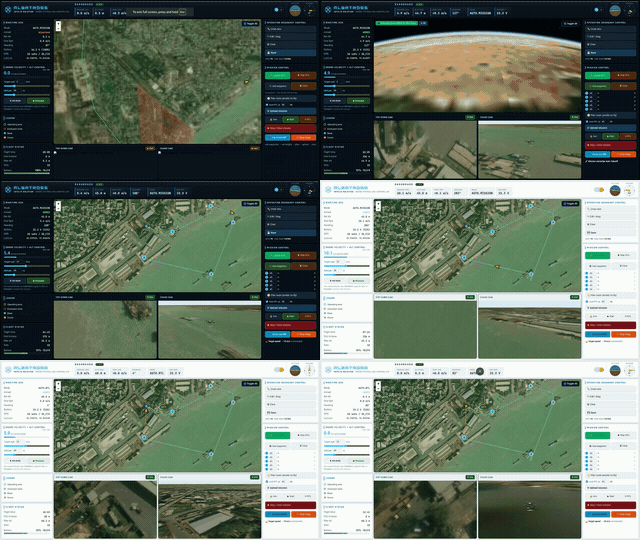
WarehouseBenchmark
A 31.8 × 54 m digital-twin warehouse benchmarking PPO, SAC, and TD3 for autonomous navigation on a Clearpath Jackal under realistic LiDAR and localization noise.
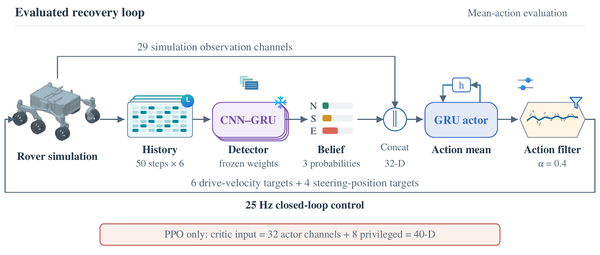
I am a final-year Robotics & Mechatronics Engineering student at the University of Dhaka. My research builds adaptive neural controllers that let robots keep moving under uncertain, deformable contact; currently, learning policies that recover a Mars rover's mobility when its wheels become entrapped in granular terrain, where classical control fails under slip.
Methodologically I focus on reward shaping with safety-gated constraints, for instance, yaw-projected rewards with entrapment-gated slip penalties, and on Sim2Real transfer through domain randomization and curriculum learning. More broadly, I am drawn to safe and preference-driven reinforcement learning, learning-based control, and neuro-robotics for movement: robots that move robustly in the physical world and learn from interaction in safe, sample-efficient, human-aligned ways.
Wheel entrapment in loose regolith has crippled real planetary missions (e.g., NASA's Spirit rover). We cast recovery as a reinforcement-learning control problem in deformable granular dynamics, learning policies that exploit terrain feedback to regain mobility, bridging RL, locomotion, and safe control under uncertainty.
A 31.8 × 54 m digital-twin warehouse benchmarking PPO, SAC, and TD3 for autonomous navigation on a Clearpath Jackal under realistic LiDAR and localization noise.
A full kinematics and dynamics stack written from first principles in NumPy, validated against official URDFs for both a UR5e and a 7-DOF KUKA iiwa. Cross-checking exposed a DH sign error worth 1.998 m; corrected, model and URDF agree to 1.5e-7.
Asymptotically optimal sampling-based motion planning for a KUKA iiwa, implemented from first principles in NumPy. RRT* searches the full 7-D joint space with real URDF collision checking, converging to within 0.16% of the analytic optimum.
A PPO agent learning soft-landing control, trained with Stable-Baselines3. The reward curve traces convergence from random exploration to precise, fuel-efficient landings.
An APPO agent trained with Sample-Factory to survive in a first-person 3D environment, learning to navigate and collect health packs from raw pixel input.
A DQN agent trained with Stable-Baselines3 on SpaceInvadersNoFrameskip-v4, achieving 527.50 mean reward with CNN policy and experience replay.
A from-scratch STM32 flight controller with cascaded PID attitude/rate loops and IMU sensor fusion, achieving stable autonomous flight.